ECR-R Guide: Free Attachment Style Test
Related glossary terms
Do you worry that partners will leave, or do you pull back when relationships get close? Adult attachment patterns shape how we trust, communicate, and handle intimacy. The ECR-R (Experiences in Close Relationships – Revised) is one of the most widely used tools to measure attachment-related anxiety and avoidance. On LuriaLab you can take the free ECR-R attachment style test online, anonymously, and see both dimensions scored on your report.
What Is the ECR-R?
The ECR-R was developed by Fraley, Waller, and Brennan (2000) as a refined measure of adult romantic attachment. It includes 36 items rated on a 1–7 scale. Eighteen items form the attachment anxiety subscale (fear of rejection, need for reassurance), and eighteen form the attachment avoidance subscale (discomfort with closeness, preference for independence). Several items are reverse-scored so that higher means always mean more anxiety or more avoidance.
How ECR-R Scores Are Interpreted
Each subscale is reported as the mean of 18 items (range 1.00–7.00). On LuriaLab, common screening bands are:
- Low (< 3.0): Relatively low anxiety or avoidance on that dimension
- Moderate (3.0–4.99): Noticeable attachment-related tendencies
- High (≥ 5.0): Stronger anxiety or avoidance patterns in close relationships
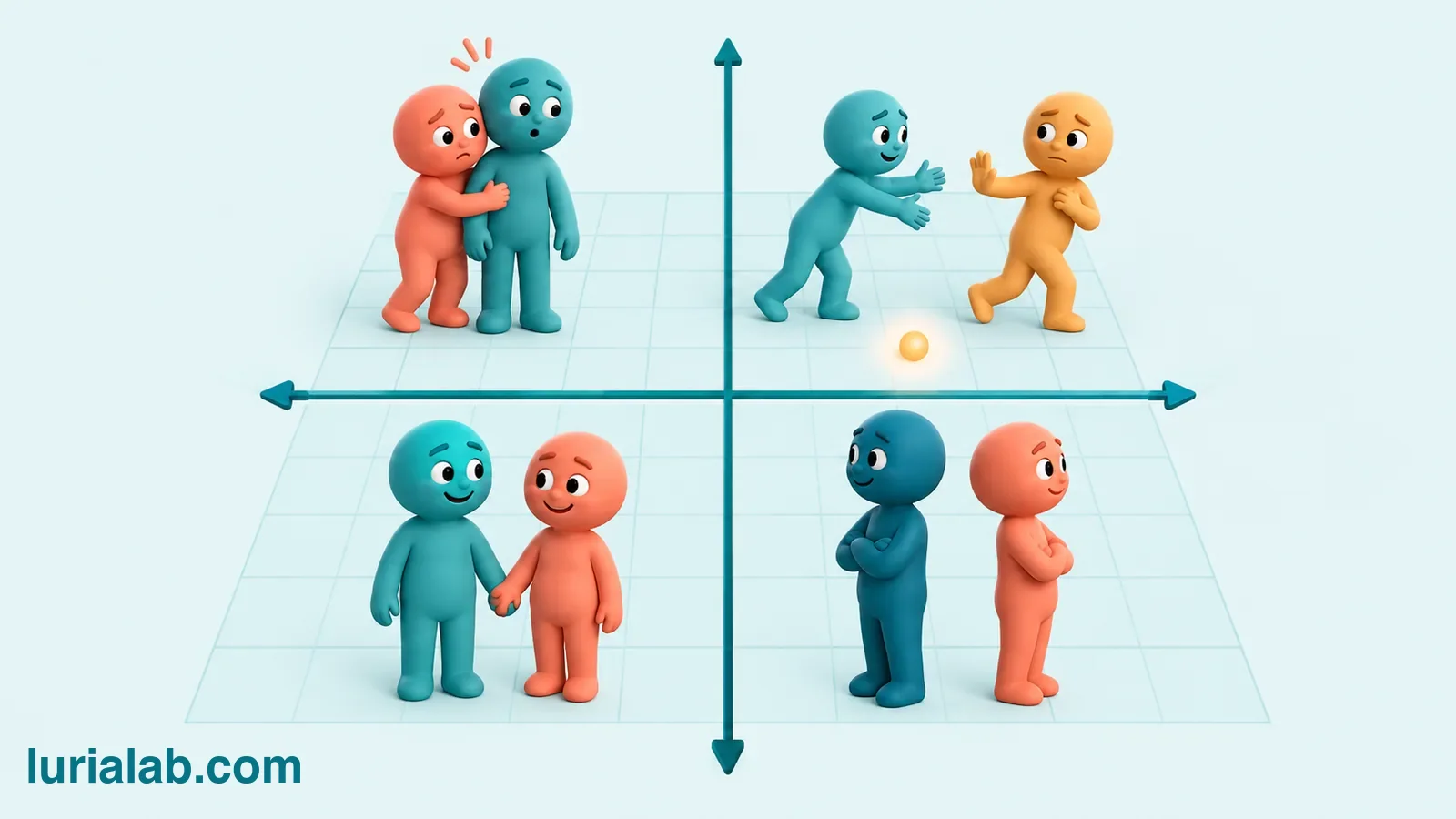
Your report shows anxiety and avoidance separately — not a single “type” label. Many people sit in different bands on each axis (for example, high anxiety with low avoidance, or the reverse).
What Do the Two Dimensions Mean?
- Attachment anxiety — worry about being abandoned, sensitivity to signs of rejection, and a strong need for closeness or reassurance. See also our glossary on anxious attachment.
- Attachment avoidance — preference for emotional distance, discomfort with vulnerability, and protecting independence in relationships. See avoidant attachment.
Together, these dimensions describe your characteristic patterns of connecting — often called an attachment style. Patterns can shift over time with relationships, therapy, and life experience.
Who Should Take the ECR-R?
Adults (typically 18+) who want to understand how they behave in romantic or other close relationships. It is widely used in research and as a self-reflection screen. The ECR-R is a screening and self-insight tool, not a diagnosis of an “attachment disorder.” Only a qualified professional can assess relationship distress in a clinical context.
ECR-R vs Other Relationship and Mood Screens
- ECR-R — 36-item attachment anxiety + avoidance in close relationships
- RSES — global self-esteem (often overlaps with relationship insecurity)
- GAD-7 — generalized anxiety symptoms over the past two weeks
If relationship stress also shows up as worry or low mood, pairing ECR-R with GAD-7 or the PHQ-9 can give a fuller picture.
Can You Trust an Online ECR-R Test?
Yes, when it uses the standard ECR-R items, reverse scoring, and subscale means. Online self-report works best when you answer about how you typically feel in romantic/close relationships, not how you wish you felt. LuriaLab scores both dimensions automatically and shows clear bands on your downloadable report.
What to Do After Your Results
- Look at both scores — anxiety and avoidance tell different stories.
- Notice real-life patterns — reassurance-seeking, withdrawal during conflict, or difficulty trusting closeness.
- Consider related screens if mood or self-worth are also concerns (RSES, GAD-7).
- Talk with a clinician or couples therapist if attachment patterns keep hurting your relationships.
- Remember change is possible — attachment tendencies are tendencies, not a fixed identity.
Take the Free ECR-R on LuriaLab
Ready to explore your attachment patterns? Take the ECR-R on LuriaLab — free, private, and available in English, Turkish, Russian, Spanish, Italian, French, German, Portuguese, Dutch, Polish, Hungarian, Swedish, Romanian, and Azerbaijani. You will get instant subscale scoring and a downloadable report.