Dissociative Experiences Scale (DES-II)
Start the test- Ages: 18+
- 28 questions
- ~4 min
- Free
РусскийУкраїнська中文NederlandsDeutschMagyarFrançaisSvenskaTürkçeEspañolRomânăفارسیPolskiAzərbaycan diliItalianoPortuguêsالعربية
Test guides
DES-II population and administration
The DES-II describes dissociative experiences in adult self-report. Age, language, reference period and assessment purpose guide instrument selection.
Who is the DES-II for?
DES-II is a self-report measure of dissociative experiences. LuriaLab offers it to adults aged 18 and over. Its broad content can help organise a conversation about experiences involving absorption, memory gaps or detachment. It does not decide which diagnosis explains them. [2] [5]
| Context | Description |
|---|---|
| Adult, broad self-reported experiences | DES-II samples a range of dissociative experiences and summarizes frequency. |
| Adolescent respondent | Consider the age-specific A-DES and its own administration instructions. |
| Recent symptom distress or interference | Check the time frame and content of the intended instrument. The DES-II mean does not directly rate impairment. |
Match the questionnaire to the question
The DES was designed to measure experiences across clinical and non-clinical populations. Some items concern relatively common absorption, while others describe experiences that may be more disruptive. That breadth is useful for description but limits what any single total can establish. [1] [2]
- For reflection: use the questions to identify experiences you want to describe more clearly.
- For clinical discussion: bring the item pattern and its effects on daily life, not only the mean.
- For research: identify the version, language, instructions and target population before comparing results.
Using the questionnaire does not require deciding that you have a dissociative disorder or a particular trauma history.
Match the measure to the person and purpose
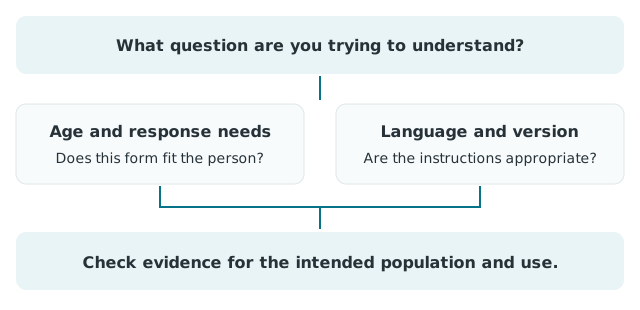
Adults and younger people
The adult DES-II and the adolescent A-DES are different instruments. A child's or adolescent's experiences should be considered through an appropriate assessment pathway rather than simply applying the adult website's interpretation bands. LuriaLab's DES-II listing specifies 18+. [5]
Age can also matter within adult samples. Findings from one recruited clinical population do not automatically establish the same reference distribution for every age or setting.
Language, instructions and versions
The 1993 authors' update discusses translating and using the DES across cultures. A readable translation and a validated interpretation are related but separate steps. Check whether the wording, response format and study evidence match the version being used. [2]
DES-II uses a revised response format compared with the original DES. When citing a study, distinguish evidence about the original scale from direct evidence about the revised administration. A shared instrument history does not make every form identical.
DES-II and DSS ask different questions
The Dissociative Symptoms Scale was developed to focus on more disruptive dissociative symptoms and uses a past-week timeframe. DES-II includes a broader range of experiences. Their item content, timeframes and score meanings differ, so scores should not be converted from one into the other. [4]
The same caution applies when a questionnaire is mainly concerned with bodily experiences or a particular dissociative symptom. Choose the measure according to the assessment question, rather than assuming that every dissociation score measures an identical construct.
When a questionnaire is not enough
Persistent or disruptive memory and perceptual experiences need a broader professional evaluation. Do not use a low total to disregard a worrying experience, or a high total to decide its cause.
If the questions are distressing, you can stop and seek support without completing them. The questionnaire is one source of information, and its completion is not a prerequisite for being taken seriously.
Keep the wider context
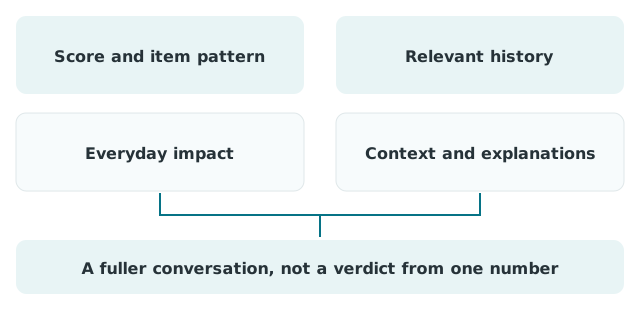
- Use the right form: Check age, language, version and administration instructions.
- Keep the context: A score cannot replace history, everyday impact and appropriate professional judgement.
References
- Bernstein & Putnam (1986). Development, reliability, and validity of a dissociation scale. Journal of Nervous and Mental Disease, 174, 727–735. DOI: 10.1097/00005053-198612000-00004.
- Carlson & Putnam (1993). An update on the Dissociative Experience Scale. Dissociation, 6, 16–27. Paper and DES-II form.
- Carlson et al. (1993). Validity of the DES in screening for multiple personality disorder: a multicenter study. American Journal of Psychiatry, 150, 1030–1036. DOI: 10.1176/ajp.150.7.1030.
- Carlson et al. (2018). Development and validation of the Dissociative Symptoms Scale. Assessment, 25, 84–98.
- LuriaLab. Current DES-II assessment listing.