Adult ADHD Self-Report Scale V1.1 (ASRS-V1.1)
Start the test- Ages: 17+
- 18 questions
- ~3 min
- Free
中文MagyarFrançaisEspañolTürkçeУкраїнськаItalianoPortuguêsNederlandsDeutschРусскийالعربيةPolskiفارسیAzərbaycan diliRomânăSvenska
Test guides
ASRS v1.1 population and administration
The ASRS v1.1 records recent symptoms reported by adults. Interpretation depends on the form, respondent, language and assessment setting.
Who is the ASRS v1.1 for?
The ASRS v1.1 is an adult self-report questionnaire for exploring symptoms associated with ADHD. It can support a first conversation about recurring attention, organisation or restlessness concerns. It does not determine whether a person meets the full diagnostic criteria. [1] [2]
| Context | Description |
|---|---|
| Recent adult symptoms | ASRS v1.1 asks about the preceding six months. |
| Childhood history recalled by an adult | The WURS-25 addresses an earlier period. Developmental history and collateral information provide additional context. |
| Concern about a child | Choose an age-appropriate measure with appropriate respondents and age-specific evidence. |
When is it useful?
It is most useful as an organised description of your own experiences. Think about the period specified by the form, answer as honestly as possible and keep examples of how the difficulties appear in ordinary life.
- Before an assessment: the questions can help you identify experiences you want to discuss.
- Within an assessment: a professional can consider the answers alongside developmental history, other information and impairment.
- After diagnosis: symptom answers can still prompt discussion, but crossing the screening threshold alone is not a treatment-outcome measure.
The screening count should not be used by itself to grant or deny a diagnosis, medication or support. NICE specifically advises that diagnosis should not rest on rating-scale data alone. [5]
Match the measure to the person and purpose
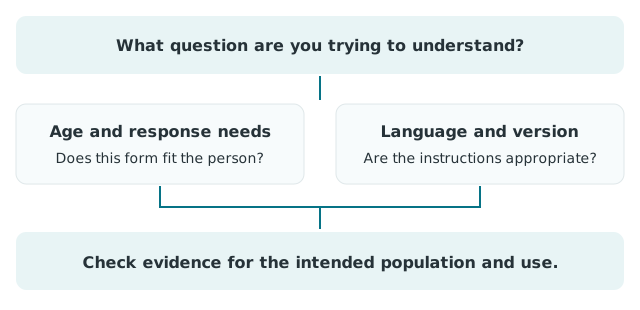
Age listing and adult evidence
LuriaLab currently lists this assessment from age 17. That access setting is different from research demonstrating performance in a particular age group. The original validation concerns adult ADHD in a US community-survey sample; it should not be treated as a separate validation in 17-year-olds. [1] [6]
Children and adolescents need an age-appropriate clinical pathway. A young person's assessment may involve information from family, education and other relevant settings. An adult self-report threshold is not a substitute for that process. [5]
Choose the right version and language
Harvard maintains the official ASRS resources, including translated forms. Use the wording, response options and scoring instructions for the actual version being administered. A translation's availability does not establish identical accuracy in every population. [2]
Check three things before comparing results: whether both used ASRS v1.1 rather than ASRS-5, whether the same six-item scoring method was used, and whether the forms were appropriate for the language and setting. The original 0–6 rule and the alternative 0–24 method describe the same Part A answers differently. [3]
When extra care is needed
In a period of major depression or anxiety, some experiences may overlap with those asked about in the ASRS. A positive result still deserves attention, but the next question is what explains the difficulties and whether more than one condition is present. The depression validation study demonstrates why performance figures from a community sample cannot simply be carried into every clinic. [4]
You do not need to complete several screening tests before seeking help. If the difficulty is persistent or affecting daily life, discuss it even when the ASRS result is below threshold.
Keep the wider context
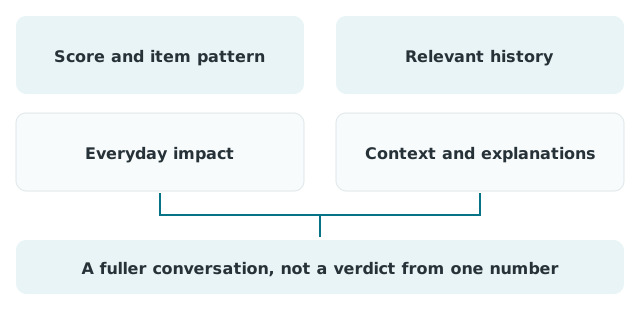
- Use the right form: Check age, language, version and administration instructions.
- Keep the context: A score cannot replace history, everyday impact and appropriate professional judgement.
Common suitability questions
Can someone else complete it for me?
This version is self-report. Another person's observations can be useful separately, but their answers should not be presented as your own completion of the instrument.
Do I need to know whether I had ADHD in childhood?
No prior diagnosis is required to describe current symptoms. A diagnostic assessment can explore earlier-life evidence and how the pattern developed. [5]
References
- Kessler et al. (2005). The WHO Adult ADHD Self-Report Scale: a short screening scale for use in the general population. Psychological Medicine, 35, 245–256. DOI: 10.1017/S0033291704002892.
- Harvard National Comorbidity Survey. Official ASRS instruments, instructions and translations.
- Harvard National Comorbidity Survey (28 February 2024). ASRS v1.1 six-question scoring update.
- Dunlop, Wu & Helms (2018). Performance of the ASRS-v1.1 in adults with major depressive disorder. Behavioral Sciences, 8, 37. DOI: 10.3390/bs8040037.
- NICE NG87. ADHD: diagnosis and management, section 1.3.
- LuriaLab. Current assessment listing.