Adult ADHD Self-Report Scale V1.1 (ASRS-V1.1)
Start the test- Ages: 17+
- 18 questions
- ~3 min
- Free
中文MagyarFrançaisEspañolTürkçeУкраїнськаItalianoPortuguêsNederlandsDeutschРусскийالعربيةPolskiفارسیAzərbaycan diliRomânăSvenska
Test guides
ASRS v1.1 scoring
LuriaLab counts the six Part A responses that meet their item-specific thresholds. Four or more meet the original ASRS v1.1 screening rule.
How ASRS v1.1 scoring works
The full ASRS v1.1 checklist has 18 questions, but its original screening decision uses the first six, Part A. LuriaLab reports this Part A count from 0 to 6. It is not the sum of all 18 response values. The remaining questions provide additional symptom information. [2]
| Part A item | Example response | Minimum counting response | Point |
|---|---|---|---|
| 1 | Sometimes | Sometimes | 1 |
| 2 | Often | Sometimes | 1 |
| 3 | Never | Sometimes | 0 |
| 4 | Often | Often | 1 |
| 5 | Sometimes | Often | 0 |
| 6 | Often | Often | 1 |
The threshold depends on the question
Responses run from never to very often. In the original method, an answer receives one screening point only if it reaches that question's threshold. Otherwise it receives zero. [2]
- Part A, questions 1–3: sometimes, often or very often contributes one point.
- Part A, questions 4–6: often or very often contributes one point.
- Part B: do not add these 12 answers to the original 0–6 Part A count.
This means “sometimes” can count on one question and not on another. A single frequency rule applied to all six items would change the scoring method.
Work through an example
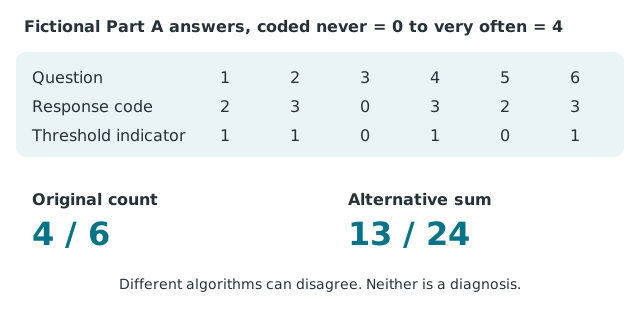
Consider fictional Part A answers of sometimes, often, never, often, sometimes and often. The item indicators are 1 + 1 + 0 + 1 + 0 + 1 = 4. The result therefore meets the original threshold of four or more.
The fifth response does not count because that question needs “often” or more. The example illustrates an algorithm, not a diagnostic assessment or a suggested pattern of answers.
Would stronger answers always increase the Part A count?
No. Once an answer reaches its threshold, increasing its frequency does not add another screening point. Sometimes and very often each contribute one point on questions 1–3. The count deliberately compresses information, which is one reason to retain the individual answers.
A closer look at the calculation
Explore the score scale
Where does an example score sit?
Move the slider to explore the numerical thresholds and their limits.

Why another ASRS score may run from 0 to 24
Harvard's February 2024 scoring note describes an alternative six-item method. Code never = 0, rarely = 1, sometimes = 2, often = 3 and very often = 4, then add those six values. The range is 0–24 and the screening cutoff is 14. The note describes advantages for research on prevalence and correlates. [3]
Same six answers, different scoring rules
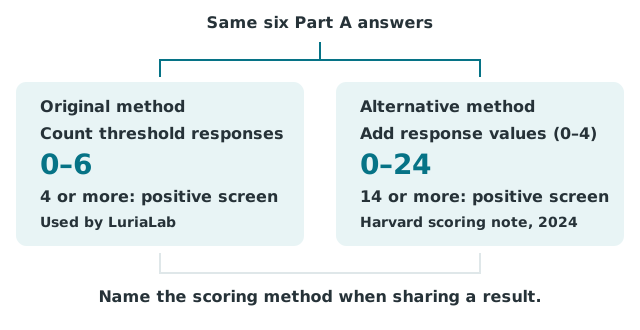
For the fictional example above, the alternative calculation is 2 + 3 + 0 + 3 + 2 + 3 = 13. The same answers meet one method's threshold but not the other's. Report the method alongside the number; do not convert 4/6 into a 0–24 result by multiplying it.
Avoid these scoring mistakes
- Missing answers: a blank is not the same as “never.” Complete the six screening questions before interpreting a count.
- Severity labels: the original count does not create validated mild, moderate and severe ADHD bands.
- Different versions: ASRS-5 is a separate instrument. Its rules should not be applied to ASRS v1.1 answers.
After calculating the number, read the results guide for its practical meaning and limits.
References
- Kessler et al. (2005). The WHO Adult ADHD Self-Report Scale: a short screening scale for use in the general population. Psychological Medicine, 35, 245–256. DOI: 10.1017/S0033291704002892.
- Harvard National Comorbidity Survey. Official ASRS instruments, instructions and translations.
- Harvard National Comorbidity Survey (28 February 2024). ASRS v1.1 six-question scoring update.
- Dunlop, Wu & Helms (2018). Performance of the ASRS-v1.1 in adults with major depressive disorder. Behavioral Sciences, 8, 37. DOI: 10.3390/bs8040037.
- NICE NG87. ADHD: diagnosis and management, section 1.3.