Adult ADHD Self-Report Scale V1.1 (ASRS-V1.1)
Start the test- Ages: 17+
- 18 questions
- ~3 min
- Free
中文MagyarFrançaisEspañolTürkçeУкраїнськаItalianoPortuguêsNederlandsDeutschРусскийالعربيةPolskiفارسیAzərbaycan diliRomânăSvenska
Test guides
ASRS v1.1 validity and reliability
Compare the original ASRS community calibration with a study in adults with major depression, including sensitivity, specificity and limits of each estimate.
Evidence supporting the ASRS v1.1
The ASRS has evidence for identifying adults who may need further ADHD assessment. That evidence concerns particular versions, scoring rules, reference diagnoses and study samples. It does not establish one accuracy percentage that applies to everyone taking it online.
| Study population | Sensitivity | Specificity |
|---|---|---|
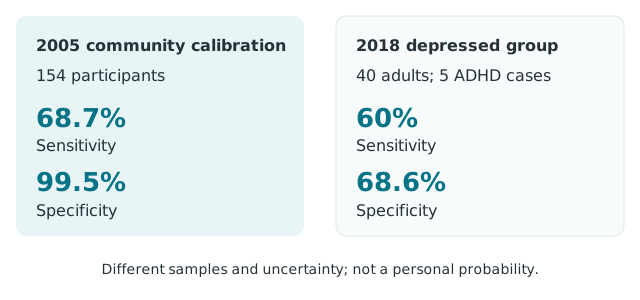
| US community calibration, 154 participants | 68.7% | 99.5% |
| Major depressive disorder group, 40 adults including 5 with ADHD | 60.0% | 68.6% |
Separate consistency from diagnostic accuracy
- Reliability: how consistently a measure captures information under appropriate conditions.
- Sensitivity: the proportion of people with the study's target diagnosis who screen positive.
- Specificity: the proportion without that diagnosis who screen negative.
- Positive predictive value: the proportion of positive screens with the target diagnosis in the relevant study or population.
These quantities answer different questions. A high specificity is not the probability that an individual positive result is correct. Predictive value depends on who is being assessed and how common the target diagnosis is in that setting.
Know what was measured
What the original study found
Kessler and colleagues compared ASRS answers with blinded clinical ratings in 154 people previously involved in the US National Comorbidity Survey Replication. The sample oversampled people reporting childhood ADHD and adult persistence. This was a clinical calibration study, not a random sample of LuriaLab users. [1]
The six-question screener had sensitivity of 68.7% and specificity of 99.5% under those study conditions. In that analysis, it outperformed the unweighted 18-question approach. The sensitivity also shows why a negative result cannot categorically exclude ADHD. [1]
A clinical sample changed the picture
Dunlop and colleagues studied 40 adults with major depressive disorder and 55 healthy controls. Five of the depressed participants met full DSM-IV ADHD criteria. For the depressed group, sensitivity was 60%, specificity 68.6% and positive predictive value 21.4%. [4]
The estimates were imprecise: the reported 95% confidence interval for sensitivity was 14.7–94.7%, and for specificity 50.7–83.2%. This is an important limit of a small sample with only five ADHD cases. The findings support careful evaluation of overlapping symptoms, not a claim that the ASRS is useless in every person with depression. [4]
Read the figures with their study context
Which scoring method was evaluated?
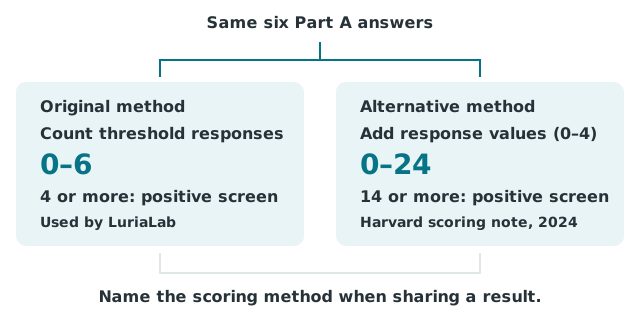
Harvard's 2024 note describes an alternative six-question 0–24 scoring method with a cutoff of 14 and discusses its use for research on prevalence and correlates. LuriaLab uses the original 0–6 shaded-response count with a cutoff of four. Statistics should be attached to the algorithm and version actually evaluated. [3]
Likewise, ASRS v1.1 and ASRS-5 should not be merged under one performance claim. A paper about one instrument or population cannot automatically validate every translation, age group or online implementation.
Applying evidence to another population
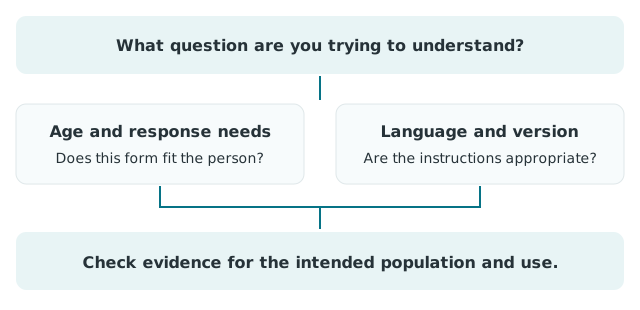
Check the age group, language, version and recruitment setting. A study estimate is not automatically a reference norm or a personal probability for a website user.
Check whether the evidence fits the use
What the evidence does not establish
The studies above do not provide a personal probability calculator for LuriaLab users, a diagnostic severity scale or a universal meaningful-change threshold. They also do not remove the need for developmental history and assessment of impairment. NICE places rating scales within a wider diagnostic process. [5]
This is a selected evidence guide, not an exhaustive systematic review. For practical interpretation, use the results guide.
References
- Kessler et al. (2005). The WHO Adult ADHD Self-Report Scale: a short screening scale for use in the general population. Psychological Medicine, 35, 245–256. DOI: 10.1017/S0033291704002892.
- Harvard National Comorbidity Survey. Official ASRS instruments, instructions and translations.
- Harvard National Comorbidity Survey (28 February 2024). ASRS v1.1 six-question scoring update.
- Dunlop, Wu & Helms (2018). Performance of the ASRS-v1.1 in adults with major depressive disorder. Behavioral Sciences, 8, 37. DOI: 10.3390/bs8040037.
- NICE NG87. ADHD: diagnosis and management, section 1.3.