Adult ADHD Self-Report Scale V1.1 (ASRS-V1.1)
Start the test- Ages: 17+
- 18 questions
- ~3 min
- Free
中文MagyarFrançaisEspañolTürkçeУкраїнськаItalianoPortuguêsNederlandsDeutschРусскийالعربيةPolskiفارسیAzərbaycan diliRomânăSvenska
Test guides
ASRS v1.1 score interpretation
An ASRS v1.1 Part A count of 4 to 6 supports further assessment. The count alone cannot establish childhood onset, functional impairment or a diagnosis.
Understanding an ASRS v1.1 result
An ASRS result summarises self-reported symptoms. On LuriaLab, the number is the original six-question Part A count. It answers whether enough responses met the screening thresholds; it does not establish ADHD, developmental onset or clinical impairment. [1] [2]
Below the original screening threshold. This does not explain away continuing difficulties.
Meets the original threshold and supports further investigation.
Describe other symptoms and provide examples for a clinical conversation.
| Context | Description |
|---|---|
| 0–3 of 6 | Below threshold. Examine persistent impairment, symptom history and any concerns outside the six selected items. |
| 4–6 of 6 | Meets threshold. Establish the developmental course, impact across settings and other possible explanations. |
| Part B responses | Document specific symptoms for follow-up. They do not add points to the Part A count. |
Put the result alongside your history
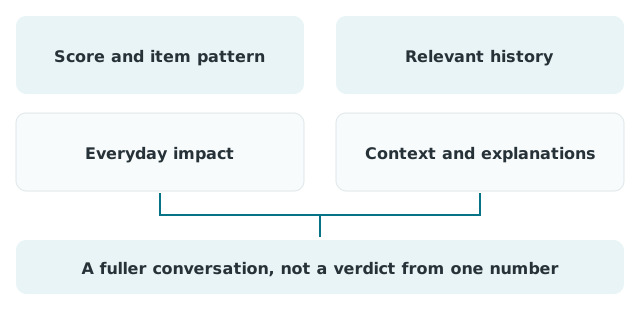
ADHD assessment considers much more than recent symptom frequency. NICE describes a full clinical and psychosocial assessment, developmental and psychiatric history, observer information and functioning across important settings. Rating scales alone are insufficient for diagnosis. [5]
- Time: explain whether similar patterns occurred earlier in life, even if their consequences were different.
- Settings: bring examples from work, education, home or relationships rather than relying on one situation.
- Impact: describe missed responsibilities, effort, distress and any strategies that help you function.
These examples are useful whether your screen is positive or negative. You do not need to prove a diagnosis before discussing a difficulty.
What a score needs alongside it
The same count can hide different experiences
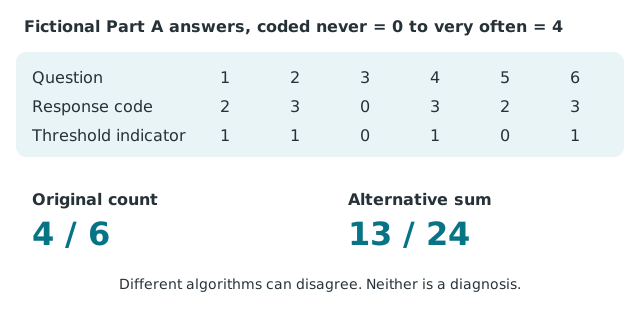
Imagine two people who each score four. One meets thresholds mainly on organisation and task-related questions; another has a different combination involving restlessness. Their counts match, but their histories, practical difficulties and support needs may differ.
There is another loss of detail within each item: once a response crosses its threshold, stronger endorsement still contributes just one point. The count cannot replace the underlying answers or rank two people's level of impairment.
Look beyond the total
What else can affect the answers?
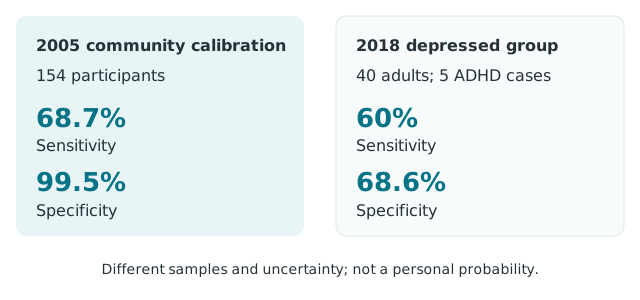
Concentration difficulties and restlessness can occur alongside mood and anxiety symptoms. In a small study of adults with major depressive disorder, positive ASRS screens needed careful evaluation to distinguish ADHD from overlapping difficulties. ADHD and depression can also coexist. [4]
A professional may ask about sleep, physical health, substance use, medication and current circumstances, alongside psychiatric history. The purpose is to understand the pattern, not to dismiss what you have reported. [5]
Why study context matters
What if the result changes later?
A changed count means some responses crossed an item threshold. It does not automatically establish recovery, worsening ADHD or treatment failure. For example, a change from sometimes to rarely on one of the first three questions lowers the count by one, even though the underlying frequency may have shifted only slightly.
When discussing repeated results, keep the date, version, scoring method and circumstances. The ASRS v1.1 asks about the past six months; frequent retesting does not create independent six-month observations. Review everyday functioning alongside any score change. [2]
A changed score needs context
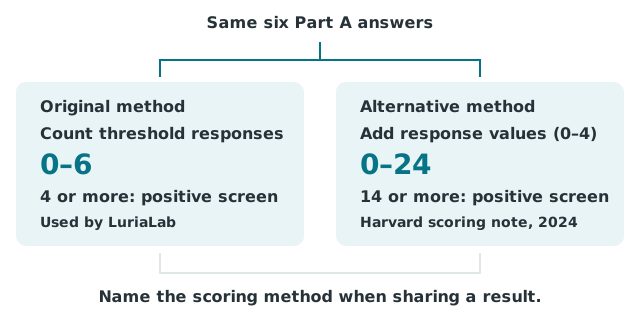
- Keep the method: compare results only when the version and scoring rule are identified.
- Keep the context: a small numerical shift or threshold crossing is not, by itself, proof of meaningful clinical change.
A practical next step
Save the result and write down two or three concrete examples. Include one from earlier life if you can recall it, one current difficulty, and something that helps. A qualified professional can use those details when deciding whether further assessment is appropriate.
For the research behind screening performance, see the validity and reliability guide.
References
- Kessler et al. (2005). The WHO Adult ADHD Self-Report Scale: a short screening scale for use in the general population. Psychological Medicine, 35, 245–256. DOI: 10.1017/S0033291704002892.
- Harvard National Comorbidity Survey. Official ASRS instruments, instructions and translations.
- Harvard National Comorbidity Survey (28 February 2024). ASRS v1.1 six-question scoring update.
- Dunlop, Wu & Helms (2018). Performance of the ASRS-v1.1 in adults with major depressive disorder. Behavioral Sciences, 8, 37. DOI: 10.3390/bs8040037.
- NICE NG87. ADHD: diagnosis and management, section 1.3.