Autism Spectrum Quotient (AQ)
Start the test- Ages: 16+
- 50 questions
- ~8 min
- Free
DeutschTürkçeMagyarPolskiУкраїнськаEspañolFrançaisPortuguêsNederlandsItalianoРусский
Test guides
AQ-50 scoring and worked example
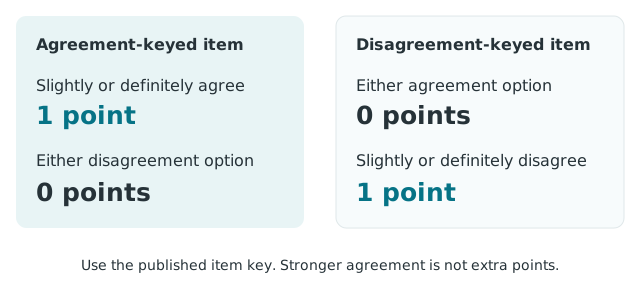
Each of the 50 answers contributes either zero or one point according to the published item key. Both strengths of agreement count alike on an agreement-keyed item.
A worked total across five domains
| Domain | Keyed responses |
|---|---|
| Social skill | 7 |
| Attention switching | 8 |
| Attention to detail | 6 |
| Communication | 5 |
| Imagination | 4 |
Adding 7 + 8 + 6 + 5 + 4 gives 30 out of 50. This means 30 responses matched the scoring key. It does not mean the person is “60% autistic.” Domain totals can help identify which experiences someone wants to discuss.
Item direction and calculation checks
For an agreement-keyed statement, both “slightly agree” and “definitely agree” contribute one point. On a disagreement-keyed statement the same two responses contribute zero. Consequently a change in response intensity within the same direction leaves the total unchanged. A change across the agree/disagree boundary can change the total by one point.
Use the official key for the language and form administered. Retain the four original responses if a data set will be rescored. Summing raw response-option numbers or treating every agreement as one point produces a different measure. University of Cambridge Autism Research Centre, forms, scoring key and errata.
| Domain | Items | What the domain samples |
|---|---|---|
| Social skill | 10 | Comfort and ease in social situations |
| Attention switching | 10 | Flexibility when focus, plans or routines change |
| Attention to detail | 10 | Attention to patterns and small details |
| Communication | 10 | Conversational cues and social use of language |
| Imagination | 10 | Representing imagined situations and other perspectives |
Range and completeness checks
A complete form yields 50 binary item scores and five integer domain sums of 0–10. Their sum equals the total. A missing response and a keyed zero have different meanings. For research analysis, document the missing-data rule in advance and report the number of complete forms. Avoid comparing a prorated total with published thresholds unless that procedure has been validated.
Educational example only. The value is separate from questionnaire responses.
Scoring materials and corrections are available from the Cambridge Autism Research Centre.
Frequently asked questions
Do I add up ratings from 1 to 4?
The standard adult AQ uses binary item scores. Assign the point using the key for each question, then sum the points.