Autism Spectrum Quotient (AQ)
Start the test- Ages: 16+
- 50 questions
- ~8 min
- Free
DeutschTürkçeMagyarPolskiУкраїнськаEspañolFrançaisPortuguêsNederlandsItalianoРусский
Test guides
AQ-50 score interpretation
The total counts responses associated with autistic traits on this questionnaire. An assessment also considers development, daily experiences and support needs.
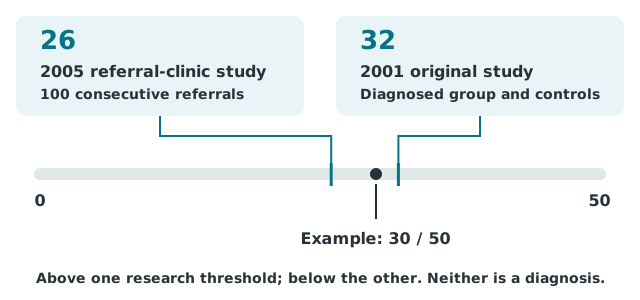
| Total | Interpretation |
|---|---|
| 0–25 | Below both research thresholds. A low score can coexist with meaningful difficulties or an autism diagnosis. |
| 26–31 | At or above the threshold explored in a referral study and below 32. Context is especially important here. |
| 32–50 | Reaches the original research threshold. Discuss developmental history, strengths, and areas where support would help. |
Reference values and the limits of a raw score
In the original English study, the diagnosed group had a mean AQ of 35.8 (SD 6.5) and the general-population group a mean of 16.4 (SD 6.3). These describe the spread within the original groups. They do not supply a population percentile for a specific individual or a threshold for support. Baron-Cohen et al. (2001), original AQ validation.
| Domain | Profile A | Profile B |
|---|---|---|
| Social skill | 7 | 3 |
| Attention switching | 8 | 5 |
| Attention to detail | 6 | 10 |
| Communication | 5 | 4 |
| Imagination | 4 | 8 |
| Total | 30 | 30 |
Documenting an AQ result
Both fictional profiles reach 30, but the distribution differs. Record examples of how traits affect activities and which settings change their impact. A ten-item domain describes a subset of answers. Interpreting a single domain as a diagnosis or as a distinct subtype would exceed the evidence.
Example report wording: “Adult AQ-50, English self-report, total 30/50. The score reaches the referral-study threshold of 26 and falls below the original threshold of 32. Developmental history, current functioning and clinical observations remain relevant to interpretation.” Include the date and whether the respondent required assistance.
For repeated assessment, changes in context, understanding of an item or access to support may alter responses. The thresholds on this site were studied for screening. They do not establish a minimum clinically important change for tracking an individual. Woodbury-Smith et al. (2005), referral-clinic validation · Ashwood et al. (2016), full AQ-50 analysis in Table 2.
Frequently asked questions
Does a higher AQ score mean someone needs more support?
The AQ measures self-reported traits. Support needs depend on the person, environment, communication needs and daily activities.